
faCellitate – Press Release
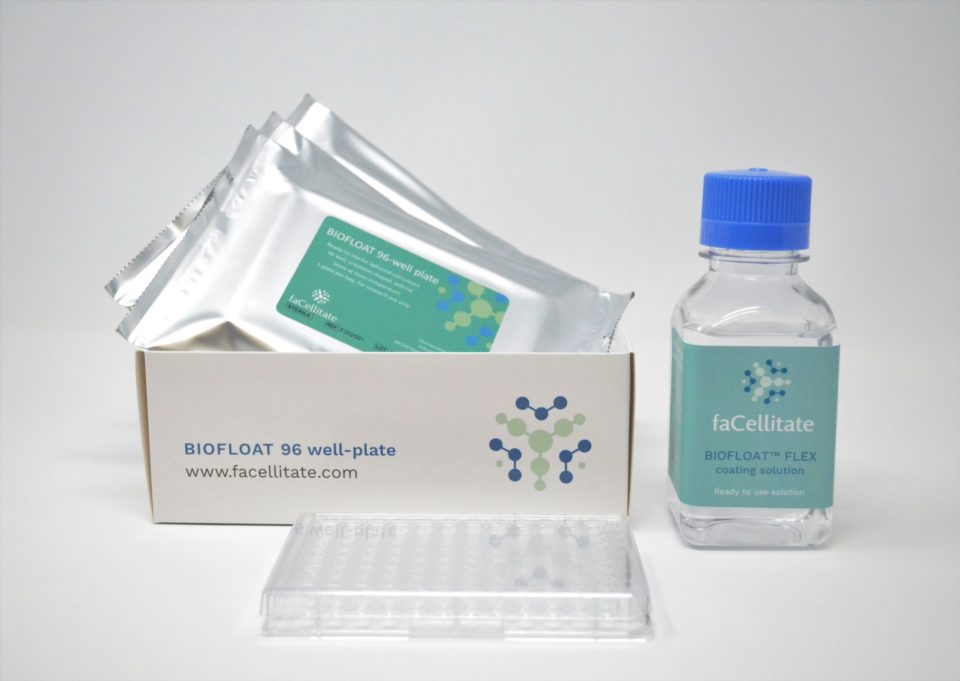
We are happy to announce that we officially launched our first product line: BIOFLOAT™. Here you can find everything about our press release. Do not hesitate to contact us for any information, we are more than happy to help!
Mannheim, May 28, 2020. Two years after the foundation of the Chemovator GmbH, the first Life Science Venture Team “faCellitate” is now ready to launch their first product line. BIOFLOAT™ are surface coatings for consumables in cell culture. The benefit: The cells can grow under conditions close to their natural environment, making laboratory results more reliable and reproducible than before. “In the long run, it is possible to increase predictability and efficiency of preclinical cell culture models, reduce animal studies and reduce the high costs for research, drug development, and toxicological studies.” reveals Dr. Véronique Schwartz, team leader and specialist in polymer chemistry. The new coatings enable the cultivation of cells for various areas of biomedical research such as toxicology, stem cell, cancer and drug research.
Imitation of natural cell environment
“Mammalian cells such as cancer, stem, or primary cells serve as basic research models when it comes to studying biological processes, disease patterns, and drug interactions. However, these cells are cultivated under conditions that do not reflect their natural environment well,” explains Schwartz. The limited reliability of cell culture models narrows the potential of biomedical research.
“Our mission is to change this by creating biologically relevant environments that our customers can use to imitate the way cells grow in the human body.” This is achieved by providing a synthetic polymer coating layer on which the cell culture conditions are adjusted.
faCellitate-surface coatings are conveniently applied to consumables such as microtiter plates, laboratory containers, or cell culture bottles. The BIOFLOAT™ technology creates a highly defined and cell-repellent surface that adapts to the shape of the consumables. Inert polymers enable cells to grow in a three-dimensional space and form uniform multicellular spheroids. With traditional two-dimensional cell culture methods, cells can only spread on the flat surface of laboratory materials.
From laboratory to market readiness
The development of the new coatings started in BASF’s Advanced Materials & Systems research. In 2018 the scientists successfully applied with their promising idea to the newly founded BASF incubator “Chemovator” and turned into the first Venture Team with the name “faCellitate”. Since then, Chemovator supports the team in developing a suitable business model. “The protected space of Chemovator proved to be a great platform for commercial validation and getting in touch with potential customers. On top, it was possible to work with BASF-experts, such as our colleagues from the Toxicology and Materials Research, but also with our external collaboration partners, researchers from the Leibniz Institute for Polymer Research at the Max Bergmann Center for Biomaterials and experienced external entrepreneurs from the Chemovator network. They helped us to quickly develop our technology to market readiness,” says Dr. Tobias Mentzel, Venture Team member and specialist in biotechnology and drug development.